


Turning 70 in March 2022, the year in which Gail Smith was born marked a significant shift for Britain. It was just a few months after the Festival of Britain and the country was soon to have a beautiful young queen on the throne. Rationing was almost over, and after years of hardship there seemed to be a new optimism in the air; causing Prime Minister Harold MacMillan to declare that ‘we’d never had it so good!’
A teenager during the decade that became known as the 'swinging 60s' for its permissiveness and libertarianism, Gail took full advantage of society’s changing attitudes to sex, multiculturalism and the role of women. And while it is sometimes said that ‘youth is wasted on the young’, that could not have been said of Gail!
An ‘out’ gay woman before turning 21, she was an active member of the Sussex branch of the Gay Liberation Front in Brighton and later became a trailblazer in her chosen career as an advertising copywriter and commercials producer. As one of the first employees of Capital Radio - where she worked for 27 years - Gail’s memories of gay London traverse the hedonistic and glitter-filled 1970s, the horrors of AIDS in the decade that followed and the more progressive period from the 90s onwards.
After talking about her time at Capital Radio, which I will come onto later, I asked Gail about ‘coming out’.
Gail: Well, when you say come out, I didn't really. The only time I ever came out, I came out to my mother. The rest of the time I was just me. And I'd always known really, I suppose. I think I knew I was gay from the age of five, but I didn't actually come out to my mother until I was 18.
Daren: So young!
Gail: Yes, I suppose so.
Daren: And this is in the late 60s.
Gail: 1970. Yeah. 18 maybe coming up to 19.
Daren: And what was her reaction?
Gail: I think she'd always known, but she didn't want to admit it. It was a little bit traumatic for me. But the most traumatic thing was when I told my sister, whom I was closest to. She burst into tears. Goodness knows what for.
Daren: And I'm just intrigued. What word did you actually use?
Gail: I said I was gay. I think she knew I was. Well, she must have been suspicious because we had lodgers, and she knew I’d had a relationship with one when I was 13 and she was 21 because mum had found a letter. So, she must have had an inkling.
In fact, in the context of oral history the mention of a letter is actually quite significant. In an age before widespread use of telephones, and certainly no emails or texting, letters were the only reliable way of staying in touch with friends and family. Which, of course, included ‘special’ friends, too! So, it was quite common for people to be ‘found out’ because of things they’d written in letters. And while it may seem inconceivable to readers who have grown up with mobile phones and the internet, in an era with few other options to communicate, people would take great personal risks in order to stay in touch with, and to express their feelings for, loved ones.
Gail: Yeah, in fact, it happened to a subsequent girlfriend of mine. Her mother found letters that I’d written to her daughter and that caused a stir. So, you know, letters could be blamed for quite a lot.
Returning to the subject of her ‘coming out’, I asked Gail to talk a little about the gay scene that she ‘came out’ into.
Gail: I didn't have any scene at all until I joined Sussex GLF. And that was a lucky mistake in some respects because I happened to see a write-up in the Argus about a disco dance that they held upstairs at what was the Co-op on the London Road. So, I thought, well, I'll go along to that. So, I went and I sat outside the Co-op, because you could park outside then. Unbelievable! You can't imagine it. So, I sat there in my little car - a fifth-hand convertible Triumph Herald. It was in the summer, so I had the roof down and there were two girls standing outside the Co-op, having a bit of a discussion.
“Well, if we get a bus, and we go home, we're not going to have time to change and come back. So, we'll just have to hang around and go in when it opens…” And totally out of character, because I was quite shy, I said, “Excuse me, but can I give you a lift somewhere?” And they looked at me. “Well, do you mean that?” And I said, “Yes, absolutely!” They lived on the seafront in Hove, so I drove them there and they said, “What were you doing sitting outside?” I said, “Well, I was just sort of watching to see who went in.” And they said, “Well, do you want to go?” And I said, “Well, I wasn't intending to.” And they said, “No, come on.” I went and I had the most fantastic night. It was brilliant.
It was the first time I'd been with, if you like, people like me and quite a lot of women. But I would have to say it was almost 50/50. And everyone was so welcoming. There was a raffle, and it was the first time I'd seen things like pillowcases with ‘his and his’ and ‘hers and hers’ and that sort of thing. Standard stuff now, but the person who was doing the raffle and spoke to us was a rather fearsome - I thought - looking female who said. “Now, don't just come along for social things. Come along to the meetings every week. I'm sure it was Tuesday evening at the Stamford Arms. So, the following Tuesday, I went along to the Stamford Arms, which is now the Joker at Preston Circus. Parked my car right outside and went into the bar. There were about five old boys sipping their pints and I thought, well, this can't be it. And then I noticed there was a staircase. So, I went up the staircase, marched into the room. Not a soul. So, I thought, right, I'm going home. And I was literally tiptoeing down the stairs when in came two women. And one of them was, who I thought was that rather fearsome female. She said, “Are you here for the meeting?” So, I said yes. She said, “Right. I'm Di. Who are you?” And I said,“I'm Gail.” And she said, “Yes, I know you are, but what's your name?” She thought I said, I'm gay. Anyway, so that was the beginning of a friendship which has lasted till today.
In fact, in the 70s, the Stamford Arms was quite well-known as a place that welcomed groups which, back then, would have been considered quite radical, such as those people drawn to their infamous folk evenings: a rag tag and bobtail of hippies and misfits that included the Sussex branch of the Gay Liberation Front. Intrigued by Gail’s involvement with the political movement born out of the Stonewall riot in 1969, I asked her to talk a little bit more about the sort of things they got up to.
Gail: If I remember correctly, we discussed things like social events, but we also had visiting speakers that came down. There was this wonderful woman who came Rose. She was absolutely brilliant. Her son was gay and she came and talked to us about the perspective from a parent, but also the problems her son faced. So, we did discuss problems and things. Most of the problems were suffered by the men because there was a lot of discrimination going on for them.
Hearing this I wondered it Gail was talking about the crime of gross indecency; cases of which had rocketed following the partial decriminalisation of homosexuality in 1967. No longer able to arrest men over 21 for having sex in private, police forces took it upon themselves to seek out anyone who fell foul of the letter of the law, which meant anything from looking at another man in the street to being involved in a homosexual act in public. Indeed, so keen were some forces to make arrests, they got their better-looking younger police officers - known as ‘pretty policemen’ - to hang around urinals in toilets that were popular with men looking for sex with other men - known as ‘cottages’ - and encourage their unsuspecting victims to make a move!
Gail: Yes, you've hit the nail on the head. In fact, I remember two guys who went to the cottages. They got caught. And one of them hadn't come out to his parents, so, to help him - I think this was before his court case - we all went to his house for tea, and he came out. I don't remember that being traumatic. Obviously, it was for him. But hopefully we made it a little easier for him to do that. In fact, I can think of 5 or 6 guys who got caught. I just thought this was so awful. Absolutely diabolical. When I first joined Sussex GLF it was mainly for social reasons but as a result of going to the meetings, I became far more aware of all the injustices that were happening, I would say, almost exclusively to the male members of the group.
Intrigued by this shift from the social to the more political aspect of the Sussex GLF, I asked her if she could recall any specific protests or events that stood out.
Gail: Well, whilst I was Chair, we organized a couple of things. One was the pubs in Brighton that were very happy to take the ‘pink pound’ but would not admit that they had any relationship at all with the gay community. So, there was one particular pub in the centre of Brighton and upstairs really was exclusively gay. So, I had this idea. Rather than have our meeting on the Tuesday, I said, let's go there and we can engage with some of the clientele. Maybe the management will let us hand out leaflets about our meetings and what we stand for. So that's what we did. We sat down. I can't remember how many of us there were. And we started just having a little chat. It wasn't really a meeting. And the next thing, the guy behind the bar comes over and says, “What are you doing?” And we said, “Well, we're having a chat. We're going to go and give out these leaflets if it's okay with you.” He had a look at the leaflet and he said, “But this isn't gay.” I said, “Do you want to tell that to your clientele?” Anyway, we were thrown out. I was rather enraged about that. So, the next week we went and stood outside and all the guys who were going in, I mean, obviously most of them were married and in the closet. We started to leaflet them and as soon as they saw the leaflet, they turned tables, and they wouldn't go in. So that was one thing we did. But whether it did any good, I don't know. It made me feel a bit better, especially when we denied them some custom. We also organized a dance at the Royal Pavilion. A disco, really. And that was liaising with Brighton Council.
Daren: And they knew who they were dealing with?
Gail: Gay Liberation Front. Yeah! In fact, my recollection is that they were very good. The only stipulation they put on was that in the Music Room nobody was allowed to smoke. We ran our own bar and disco, and it was highly successful and brilliant. Most people dressed up.
Daren: I have to ask, in Regency outfits?
Gail: No, no, no. But rather than pitch up in jeans, I did look reasonably smart. And it was very, very successful. I'm sure there was another one, but I must have either been away or I had started working in London.
As mentioned earlier, Gail had a very successful career in commercial radio in London, but before moving onto this chapter of her life, I asked her to talk a little more about the gay scene in Brighton in the 1970s.
Gail: I was working in London but traveling back to Sussex. So, my social scene was very much still Brighton based. I would be going to various clubs. There was the Long Branch, Binny's, the Queen of Clubs. But the main one I went to was the Regency. Run by a couple of boys, it was, of course, down in the basement where a lot of these clubs were. From the outside it looked like an ordinary residential building. But you went down the steps to the basement, you'd ring the doorbell and a little thing would slide back over the grill. And if you were approved, you’d be let in. They had a jukebox, which you had to pay for. And then come 11pm, if you wanted to stay, you had to have the supper, which was this awful sort of frankfurter thing and a bit of instant mashed potato, so that the license wasn't breached.
Daren: Which was probably true of all straight venues as well at the time.
Gail: Absolutely. Yes, it was.
Daren: And what was the clientele like in there?
Gail: It was quite mixed… as was the Long Branch. But I used to like the Regency. It had a very nice, relaxed atmosphere. Wasn't very big. As you can imagine, being an old Regency house and just the basement. But you felt safe. It was fun. You were with your own kind.
It’s a view echoed by almost everyone I have talked to as part of this project. Before the arrival of dating apps, gay clubs and pubs were the backbone of the queer community. Places where, as Gail says, you could be with ‘your own kind’ - often for the first time. Of course, even back then the LGBTQ+ community was a broad church, so I wondered to which ‘tribe’ Gail belonged. In particular, I was interested to hear about her experience of women who referred to themselves as either ‘butch’ or ‘femme’.
Gail: There was very much a division. It was quite apparent which side you were on. And yes, I suppose I would definitely be on the butch side, but not to the extent that… there were some women who would dress in three-piece suits, for example. And there were some ultra-feminine women as well. So, I was sort of slightly to one side of butch.
While masculine-looking women were quite commonplace by the 1960s, it was the release of Robert Aldrich’s queer cult classic, The Killing of Sister George, starring Beryl Reid, Susannah York and Carole Browne, that really brought the concept to the attention of the general public. The story of an aging TV actress in a lesbian love triangle - it also brought infamy to a lesbian bar that had existed in some form since the 1950s; the Gateways off the King’s Road, Chelsea. On mention of the club, I was absolutely thrilled to hear that Gail had actually visited the place in the late 70s.
Gail: I went a couple of times and the first time I went; I just couldn't believe my eyes. It was incredibly divided. It was butch. There were a lot of suits there, a lot of collars and ties.
Daren: So, did you meet any of the gang? Gina? Smithy?
Gail: Smithy, yeah. I didn't ‘know’ her, but she was behind the bar the few times I went. The first time I went, I was so nervous. I actually went on my own. I was watching people going in and down the stairs, and I thought, I'm not going to see them again. Then I plucked up courage and I went down. And of course, I'm only five foot and three quarters of an inch and this very, very tall woman looked down at me. I said, I was hoping I could come in for a drink and she should looked me up and down and said, “Alright then!”
Daren: Do you think that was Gina?
Gail: I don't know, to be honest. And I went in and as I say, it was a real eye-opener.
Daren: Mainly women?
Gail: Yeah. I think all the times I went. And that's why I remember. Because I was shocked.
Daren: Yes. Because I think that by that point it had become exclusively lesbian. And do you remember at all the mural on one of the walls?
Gail: I remember there was one. But the thing I remember most from back then was queuing for the loo.
Daren: The loo is described as being almost like a separate meeting space.
Gail: It was very much so. Yes, I remember some interesting conversations there. It was always busy in those days. We'd have a drink. I don't remember any drugs at all then.
Daren: Yes, that's the impression I got from Jill Gardiner's book, that it wasn't (druggy). I think the management was very against that. They were obviously very...
Gail: Very strict. Yes. Having said that, I don't remember any in the Regency or the Long Branch, either.
Daren: So, another pub that comes up is called the Robin Hood. Did you ever go there?
Gail: No, I didn't. But I knew of it. And I knew people who had been. I’m really not very good with names (of clubs)… but the chap who employed me at Southern Television and then Capital Radio, he took me to a couple of clubs he was a member of in London, and I remember being the only female. That never really bothered me because the guys were always very respectful. In fact, the only time I remember not being so comfortable was this wretched club in Kemptown. I remember the first time I went there, I was aware that I was getting looks like. What are you doing here? They weren't very welcoming. But that was the only time I ever felt I wasn't welcome. Even now, I would say the majority of my closest friends are men. Well, gay men. I didn't have a problem at all. I guess maybe I was just lucky with the people that I mixed with. But, no, there was never an ‘us’ and ‘them’. I would have to say, the only thing like that was between Sussex GLF and CHE, the Campaign for Homosexual Equality. The two groups were very different, and I think CHE looked upon us - I'm not talking about the Sussex branch, but GLF in general - as being too radical. They were really much more social. You know, they organized lots of events and things like that. I don't remember them organizing any protests, whereas GLF, of course, did. There were quite a lot of the protests organized, particularly in London.
Picking up on the mention of protests and the existence of organisations like CHE, that appealed to specific audiences within the civil rights movement. I was interested in finding out whether Gail was aware of any groups that were solely concerned with lesbian rights or whether she had any dealings with the Women’s Movement in general. Was she aware of any films or TV shows that included lesbian characters? Does she recall buying any books or magazines that were aimed at politically-minded women?
Gail: Well, Spare Rib, although it didn't really do me a great deal of good, but I always hoped that maybe in the small ads there might be something. I mean, I remember Time Out became very important to me. In the 80s. I'm not sure about the 70s. In the noughties I would read Diva. I don't remember there being anything like that back then. I do remember buying a couple of magazines I found in a newsagent in London on the top shelf, which were obviously aimed at a gay people, perhaps not just gay women.
Daren: And in terms of books and films, were there any books that stood out? I mean, a lot of the women I have spoken to in this project talk about the 'Well of Loneliness' by Radcliffe-Hall.
Gail: I was going to say that yes, because that was the main book I remember, too. And I remember very much a TV program. It was a ‘Play for Today’ and I suppose this would have been in the 70s. I just remember it had Virginia McKenna in it. She was a school mistress and, of course, it ended in suicide, like most gay women's things did back then. And I remember watching that with my grandmother and feeling very embarrassed, because I think they kissed, which was unheard of. It was quite apparent that there was a relationship there.
Daren: And were you aware of the Stonewall Riot?
Gail: I was thinking about this. I must have been, but it didn't sort of hit me. I was out enjoying myself. I didn't particularly read newspapers much. I was out either clubbing or in a bar or doing something I shouldn't have been. No doubt. So, I didn't really have a great deal of access to the news. But I must have sort of been aware of it.
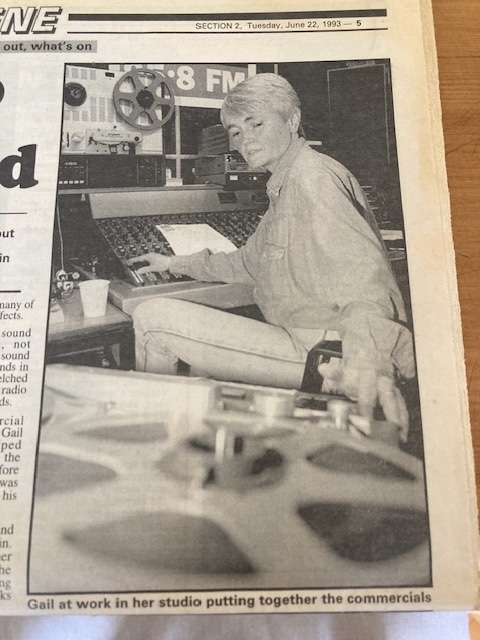
Of course, the other thing that kept Gail busy during the 70s was her job as an advertising copywriter at London’s top commercial radio station, Capital Radio. Myself, a copywriter for 30 years, I was keen to discover more about her time there.
Gail: I'd be 19 going on 20. I was interviewed by this wonderful chap who was obviously gay, and he saw instantly that I was too, and he offered me the job there and then. So, I went to work for him at Southern Television. I worked there for a year and just before the year was up, this wonderful boss of mine, John, took me to one side and said he'd been offered a job at this new place that was starting called Capital Radio. Would I like to go and work with him there? I’d never heard of it, but I thought it sounded fun. So, I resigned and off I went to Capital Radio.
Daren: So, when you said he knew you were gay, ‘obviously’, what was it? I'm just intrigued. What were the giveaway signs?
Gail: I guess just my whole manner. I mean, it was apparent to me he was gay. And in the nicest possible way. I mean, he was smart, and he could tell I was a club member as well. And we're friends to this day. Which is lovely.
Daren: So, Capital Radio.
Gail: Well, I went there just before we went on air. We launched on October the 16th, 1973, and I stayed until the very end of 2000. I saw it through all sorts of ups and downs, and it was just the most sensational place to work.
In fact, during her 27 years at Capital, Gail not only worked with some of the most famous voice-over artists of the day like Joanna Lumley, John Hurt, Miriam Margolyes, but by learning how to manage the technical and production side of things - as well as writing the scripts and coming up with the concept for the ads - she also led the way in how radio advertising is done today.
Gail: There was us and LBC. We were closely followed by BRMB in Birmingham. But everyone had copywriters, producers and engineers. And I became one. I did all three jobs. And that set a standard, I think, for the industry because that's what you’ve got now.
Producing radio adverts for a whole range of products, I wondered if Gail could remember any of her ads from back then.
Gail: I did the launch on radio of the very first shop for Kickers Shoes. I wrote this jingle ‘Your feet need Kickers’. That's all I wrote. But it worked. I used to use professional jingle companies, but when there wasn't a big budget, I used a couple of the presenters who could also sing. Graham Dene, who did the Breakfast show, and a lady called Sue Cook, who went on to do all sorts of things, including Children in Need and Crimewatch. But I think the campaign that I liked most was for the Royal Albert Hall. ‘The Royal Albert Hall, all round entertainment for London.’ It was very simple, but it just struck me, and they used the strapline for a long time.
Armed with the experience from her time at Capital, in 2000 Gail started her own radio production company which she ran until she retired. But before we leave the 1970s, I asked Gail if she could sum the decade up in three words.
Gail: 'Exciting'; because it was for me, mainly because of the social life. I now had a life that I’d always known I wanted. I found my people. So it was 'exciting' because of that, and also because I was embarking on a career that for the first time allowed me to be amongst my own kind and made the most of being young, doing what I wanted to do. We had no money, of course. But even so, that didn't really matter. The other thing I put down was ‘glitter’, because of what was going on in music. And the third thing that struck me were the 'strikes'. They impacted on everybody. During the three-day week we had no electricity for a lot of the evenings. I seem to remember that we had a meeting at the Stamford Arms and we had candles. And also coming home on the train one evening and as we were pulling into Haywards Heath seeing all these flickering candles in the windows. Even Capital Radio went on strike. I was against it, but I stood on the picket line. It was really unfortunate, as my father became very successful. And although I had no contact with him for a long, long time, he was knighted. So anyway, there were four of us on the picket line and this photographer came along. The next thing is, I got a phone call from my father, rather annoyed that his daughter had been on the front cover of the Morning Star! So that didn't go well! And of course, we had the bin men’s strike. Rubbish was piled up in the streets of London. There were rats everywhere. It was awful. The radio strike meant I was even poorer and it took a while to recover. But even so, fortunately, the strike only lasted for as long as the summer did. We didn't mind standing on the picket line in the summer. As soon as the autumn came, we settled and went back. So that was that. We were fair weather strikers at Capital!
Now known as the Winter of Discontent, the multitude of strikes between September 1978 and February 1979, ultimately led to the fall of the Labour government and the beginning of 18 years of Tory government; a shift to the right that would have a huge impact on the lives of queer people during the 80s and far beyond.
And while Margaret Thatcher cannot be blamed for a ‘new’ disease which seemed to be mainly affecting sexually active gay and bi-sexual men, the attitude of many in the Tory Party likely reduced the importance they put on helping to stop its spread or caring for those who became ill. At least at the beginning of the pandemic. And certainly, the pernicious and cruel wording relating to queer people enshrined an amendment to the Local Government Act in 1988 (Section 28) had the ‘iron lady’s’ hands all over it. Echoing sentiments about the LGBTQ+ community made in some of her speeches on the subject, such as ‘children being taught that they have the inalienable right to be gay’ or that anything other than a mother and father is a ‘pretended family’ - the full effects of the Section 28 on the LGBTQ community will never be known. But by rubber stamping the homophobia that had become commonplace as a result of the AIDS pandemic, it is probable that together with their lacklustre and tardy response to HIV, her Government’s actions almost certainly contributed to many unnecessary deaths in the UK. What is more, remaining on the statute books for over a decade, Section 28 continued to deprive many young queer people of the protection they needed at the age when they were most vulnerable, long after Thatcher's Government lost power.
Turning to this dark period, I began by asking Gail when she first became aware of the ‘gay cancer’.
Gail: I tried to do a bit of research about this, and I'm pretty sure it was 1983. I know there were some TV programs. And that's when it really hit home. BBC did them, of course. I think one was Panorama, and I remember being really shocked. And also at the same time, a friend of mine who I worked with, he became ill. And we realized that he had contracted AIDS. So that's when it really, really hit home. And I worked with quite a lot of gay guys. As far as I was aware for two decades, I was the only female who was gay, but there were quite a lot of gay men at Capital Radio. And so, because of them, I was aware, and they were talking about it a little more because obviously they had friends or partners even. But this particular friend of mine, he died. And I remember going to his funeral and thinking, I do hope this is the only one I go to for this reason. And of course, sadly, it wasn't.
Daren: If it's not too painful, how many would you say you did go to?
Gail: Ten. Maybe more. It was interesting because there was a chap who I was very fond of. He passed in 1980 aged 31, something like that. And it was only decades afterwards, I wondered if he’d actually got AIDS. I mean, the reason given was something else. But just thinking about it, all the symptoms he had were totally AIDS. Yes, it was a dark time for the whole gay community, without a doubt. Absolutely awful.
Daren: And when did you first hear about Clause 28?
Gail: Well, I was aware of it and remember being pretty disgusted that this was being allowed to happen. It was such a retrogressive state for us even though it didn't particularly affect me. I mean, you know, had I have been a teacher, which quite a lot of my friends were, it would have affected me a lot more. But the work that I did, it didn't really. Though the interesting thing was that… and I have no proof of anything, it might just be coincidence, but it was a bit after this that a lot of my gay male colleagues left. Well, I say left. They just went. And I don't know. As I say, it could have been pure coincidence because they just moved on to another job. There were some redundancies around then. But I'm thinking, we're diminishing. I'm probably totally wrong, but it just made me very, very unsettled because of that. Obviously, my friends and close colleagues knew, but I didn't go around shouting about my sexuality. I'm sure the powers that be probably knew. So, yes, it unsettled me.
Daren: And the industry you you were in was probably one of the more liberal ones to be in. I mean, it was showbiz. And what I'm hearing is that even in entertainment, there was a latent homophobia that was starting to become more outward facing.
Gail: I think that's correct, because I do recall a colleague saying to me, because of what I just mentioned about gay people just going. He said, “I think we better keep our heads down.” So, he obviously felt unsettled the same as I did. As I say, I have I have no proof of anything but the whole thing was just… It was an unsettling period, really, as far as work was concerned by this time.
Considering the great strides forward in LGBTQ+ rights that have taken place in the UK since this dark period, it’s difficult to explain to anyone who wasn’t there, the sheer level of fear felt by queer people at the time. In addition to physical and verbal abuse there was now the worry that you may lose your job or home (or not get either in the first place). And worse than that, as a result of Section 28, many lesbian mothers feared they would lose their children, too! As before, I asked Gail how she might sum up the 80s.
Gail: Here we go again. First word, 'change'. Change for me was that I was in a relationship that had lasted longer than a month. Change was because I’d been promoted at work. As I had more responsibility, I was working longer hours, but I had a bit more money, so change as I moved. And the other one would be 'AIDS'. Because that was just awful, horrendous. I remember sitting there, and actually I don't cry, but I actually had tears running down my face when I saw the John Hurt TV ad. So, moving, but so frightening, which of course it was meant to be. It had to be frightening to hit home. But also, I think it was to make the general public aware that this wasn’t just something that was being inflicted on gay people, as indeed it wasn't, anyone was at risk. Particularly if you used intravenous drugs or you were slightly promiscuous. That commercial will live with me for a long, long time.
Yet while the 80s is often seen as the decade defined by AIDS, in the UK, the numbers of deaths associated with the condition continued to rise well into the 90s - before the arrival of combination therapies using anti-retroviral drugs began turned the tide. And while this breakthrough went some way to reduce the levels of homophobia that had been gradually rising since the mid-80s, sadly, for many of Gail’s circle it came too late.
Gail: At the beginning of the 90s I was very settled in my relationship. Settled in my job. It was all going well. And I remember that people were ‘coming out’. New recruits to Capital were no longer afraid to say they were gay. I'm talking about men. I was still the only female at this point. They seemed a lot more open and, if they were that way inclined, to be a lot more flamboyant. Which was great. And it also meant, as far as my working life was concerned, that we were back to having a lot more freedom in terms of expression on the station. Camp references and things like that. We also got Kenny Everett to come back to Capital Radio. And you couldn't get much more flamboyant and camper than that! He was actually a dear friend, and I used to have lunch with him and another presenter in the restaurant at Capital. We always sat in the window because they liked to have him on show. He would always pay the bill, but he always said, "Darlings, I don't pay them. They just want me to be seen!" I knew he paid. He was the most generous, lovely guy. And when he died of AIDS, that was awful. I was really upset about that.
And just a little anecdote about Kenny Everett. I’d won an award and had to go to the Grosvenor Hotel to receive it. There was a big ‘do’ on and I got there and went into the VIP section where Kenny was. And people were coming up to him, the bigwigs from advertising… and he said, “This is dreadful. Let's get out of here!” So, we went up to the general bar and he said, “Now I am like the Queen Mother. I don't carry any money.” So, I bought him a large vodka and tonic. And when he became ill, I sent him a card to say, get well. He sent me a card back, which I have to this day, and it said, ‘Dearest girl, because I owe you that drink, this card has been infused with gin, just add tonic, ice and lemon.’ He died not long after that, so I have a perpetual drink from him. He was a lovely man. So, his passing was incredibly sad. And of course, AIDS became even more to the forefront because of his profile.
Thankfully for Gail and all of us that made it through the 80s, if a popular song of the day was to be believed, things could only get better. Though, of course, it was never going to be a smooth ride, as the road to getting an equal age of consent was to prove. Having remained at 21 for gay men (with no law at all for lesbians), in 1994 the lowering of consent to 18 resulted in what the right-wing press called a 'gay riot' outside the Houses of Parliament. Being there myself that evening I wondered if Gail had been aware of the uproar.
Gail: Yes, I remember that. I was aware because I was thinking. Okay. Alright. You've moved a bit. It's progress, but it's not equal.
Finally lowered to 16 under the Labour Government of Tony Blair, who swept to power with a landslide in 1997, there were still significant numbers of people in the UK who opposed the way the country was becoming more progressive and liberal, sometimes erupting in horrific acts of violence like the attack in 1999 on the Admiral Duncan pub in the heart of London’s gay village in Soho. I asked Gail about her memories of this brutal act of terrorism.
Gail: The radio station was around the corner. We were based in Leicester Square by then and I used to go with a couple of the gay guys from Capital, a couple of the engineers, to various pubs near Compton Street. I’d never actually been in, but I’d walked past and always fancied going in there because it looked such a joyous place. It was always crammed full of guys. I was appalled, absolutely appalled. In fact, I was sickened.
Targeting ethnic minority communities in Brick Lane and Brixton as well as the LGBTQ+ community, the nail bombings were a cursory reminder of the prejudice that is never too far from the surface. Though on the whole, for most gay people, the 90s marked the beginning of a brighter future. Something that was echoed by Gail’s summary of that decade.
Gail: 'Stable'. I was in a stable relationship. I'd been promoted again, so I felt pretty secure in my work. Dinner parties had replaced going to pubs and clubs and I moved to the house I’m in now, where I feel very peaceful, right in the country, overlooking fields. So, I was solvent and comfortable, financially. But I was also a little 'fearful' because by the end of the end of the 90s, I was slightly worried about my job situation because of changes that were going on. And also, for the first time I realized that I was getting old, you know, that I’d probably got more behind me than I’d got in front of me. And also by this time I was going to more funerals than weddings. So, there was that. But there was also an underlying 'optimism' because I’d seen so many changes as far as the gay world went. I mean, I was quite taken aback in some respects by how far we’d come.
Which brought me quite neatly to talk about Gail’s civil partnership.
Gail: I was in the relationship for 13 years in the 80s and 90s. Unfortunately, that broke down. But we’re still good friends. As I said before, I was a little bit shy, but also incredibly lazy as far as going into bars and meeting people. But Time Out became very important because they would take personal ads from gay people. There were a lot of publications that wouldn't! And so, I met my first long term partner through an ad in Time Out. And, you know, these ads, you had to fill out a form about yourself and what I was looking for, post it to Time Out, pay some money, and then you'd sit back and wait for the letters to flood in. And actually, I met some really nice people as a result of that. And that was the first one. 13 years together. Not bad for what was probably about £2.50. And then in the 90s, we broke up I put another ad in. It was a bit more like £43.50 this time. But we'd made progress here. I had to go to a phone box to receive my messages. And as a result, I met the partner that I'm now with. And so, we decided we should really have a civil partnership.
Though as I was to discover, before she could do that, there was the small matter of a previous marriage to sort out, which took our conversation back to those heady days of glitter and gay protests of the early 70s.
Gail: I got married by mistake. A Barbadian friend. He and I went on holiday to Barbados and when we were leaving the UK, he was told that his visa needed to be renewed. So, when we got to Barbados, he went to the to the High Commission. I remember him coming back to the car that we had and he said, “I don't know what to do,” because he’d got an important meeting back in London where he was working and they told him it was going to take a minimum of three weeks to get this visa through. We were only there for two weeks. So, we pondered things, and he anguished - and it was me actually - I said, “Well, could we get married? Would that work?“ So that's what we did. We got married. But when we got back to Heathrow, we were both taken aside and hardly questioned. I don't think it's anything like it is now. I think I was just asked what his mother's first name was, what his father's first name was and where they lived.
Daren: And you got those correct.
Gail: Yes. So, I was glad that I was able to to help a friend in need.
Yet another fabulous story, supporting my earlier point that the common complaint that youth is wasted on the young, could never be applied to Gail!
And as if being able to enter into a civil partnership with her partner wasn’t enough of a happy ending, having to get a divorce also resulted in Gail tracking down her old friend, rekindling a relationship that she thought she’d lost forever!
It was also a great way to introduce my final question about how she feels about being a queer elder. One that she answered with the aplomb you might expect from an accomplished copywriter and wordsmith.
Gail: Well, I’d rather be a queer younger, that's for sure! But yes, I do feel very grateful that I'm still here. Because so many aren’t, who are better people than I am, and a lot of them I miss so much and think about almost every day. And the other thing is, knowing how far we've come and what we’ve achieved as a community - and carry on achieving - I’m very proud to have been a part of that and hopefully made a little bit of a difference when I was able to. But in the main, I look back and think I was very, very lucky.
Daren: Well, take it from me. We're very proud of you. Your contribution. We're all standing on the shoulders of giants.
Gail: Well, I'm only five foot and three quarters of an inch, so you not going up very high, but the three quarters makes all the difference.